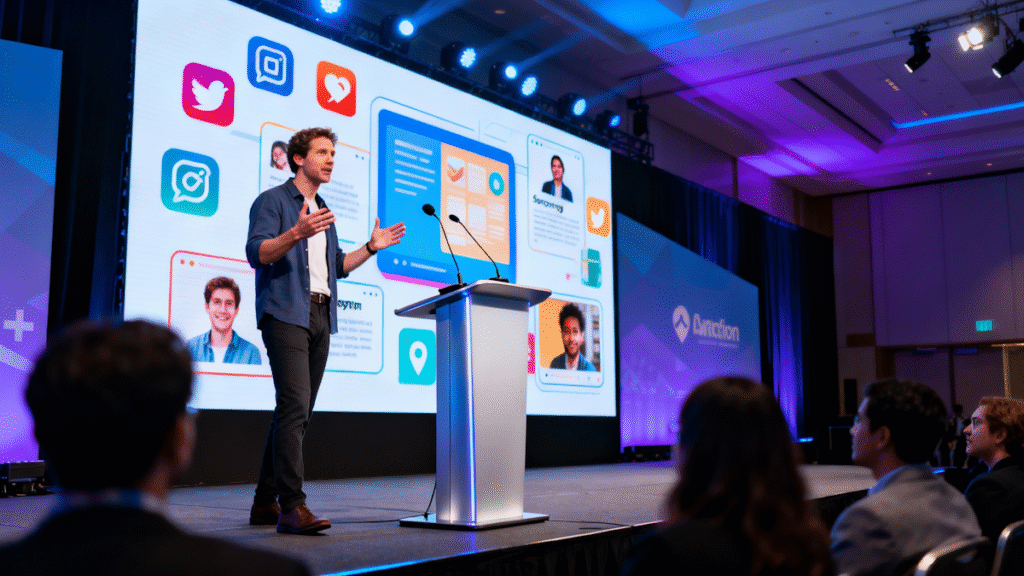
A few months ago, I worked with a keynote speaker who had everything most professionals strive for: stage presence, clarity, and a message that consistently earned him repeat bookings.
But online, he felt invisible.
“I post all the time, but nothing lands,” he told me.
When I reviewed his content, the problem wasn’t effort—it was context. He shared great clips and smart insights, but they floated without meaning. There was no story attached to them. And in today’s attention economy, context is the delivery system that makes ideas stick.
That realization ultimately shaped a storytelling framework I now use with entrepreneurs, leaders, and small-business owners who want their ideas to resonate beyond the room they’re spoken in.
I told him something simple:
“You’re sharing moments. But you’re not sharing meaning.”
Professionals, whether they’re speaking onstage, leading internally, or publishing thought leadership often assume the message alone is enough. But the message is only half the story.
The other half is the human environment surrounding it:
• Who was in the room
• What challenge they were facing
• Why the message mattered
• What changed afterward
Once he began adding that context, his content shifted. Engagement doubled within weeks. And months later, event organizers were referencing his posts when booking him. The turning point wasn’t production quality. It was storytelling.
And it underscores a broader truth relevant to anyone communicating in the modern workplace:
People don’t connect to performance. They connect to purpose.
Whether you’re leading a team, building a brand, or sharing ideas online, the narrative framing around your insight determines whether people remember it—or scroll past it.
Based on this work, here are three story types leaders can use to make their communication more effective, memorable, and actionable.
1. The Room You Walked Into
Before every message, there’s a scene.
Leaders often skip over this part, but it’s where emotional relevance begins. Was the team burnt out? Were students facing high-pressure decisions? Was a leadership group struggling to communicate?
Describe the room. Feel the energy. Understand the stakes.
Why it works: Research on narrative transportation shows that people engage more deeply when they can situate themselves inside a story. Context helps colleagues and audiences understand why your message matters.
Instead of saying, “I spoke to a sales team about resilience,” try:
“I walked into a room of 40 reps who had just missed their quarterly targets and were questioning their confidence.”
That single line turns information into meaning.
2. The Moment the Energy Shifted
Every meaningful exchange has a turning point. The moment something lands.
• A question that makes the room go silent
• A story that shifts someone’s perspective
• A truth that reframes the problem
• An unexpected insight that creates clarity
This is where your lesson lives. It’s also the moment people remember.
Why it works: Leaders often focus on the solution, but the “energy shift moment” reveals the impact of an idea in real time. Humans pay attention to contrast, before/after, tension/resolution, confusion/clarity. When you name the moment, you amplify the insight.
Instead of summarizing your message, describe what changed in the room when it clicked.
3. The Transformation That Followed
This is the most overlooked and most persuasive part of effective communication.
After the meeting, conversation, or presentation, what happened?
• Did a manager finally understand a team dynamic?
• Was there an employee who spoke up for the first time?
• Did a team leave with renewed clarity or direction?
These aren’t grand success stories. They are human signals of progress.
Why it works: In leadership communication, transformation is the proof. You don’t have to say, “This worked.” You can show it through the shifts you witnessed. It’s impact without self-promotion.
And when employees or stakeholders see the effect of an idea, they internalize the idea itself.
Why This Matters for the Future of Work
In an era where every professional is a communicator, whether on Zoom, Slack, LinkedIn, or a conference stage, the differentiator isn’t frequency. It’s resonance.
Workers are overwhelmed by content but hungry for meaning. Teams want leaders who can translate experiences into insights. And audiences reward stories that reflect real people and real situations.
The takeaway is simple:
If you want your ideas to connect, share the meaning of the moment not just the moment itself.
Start small. Think of a recent meeting, presentation, or conversation. Write down:
• The room you walked into
• The moment the energy shifted
• The transformation you observed
Turn it into a short internal message, a social media post, or a talking point for your next meeting.
Chances are, it will resonate more deeply than any isolated tip or information-only update.
Because people don’t bond with “content.”
They bond with stories of real people, real moments, and real change.
By helping speakers turn their experiences into stories that resonate, Viral Z gives them a simple, human, and repeatable way to stay visible without feeling like they’re performing for the algorithm.
Hi, this is a comment.
To get started with moderating, editing, and deleting comments, please visit the Comments screen in the dashboard.
Commenter avatars come from Gravatar.